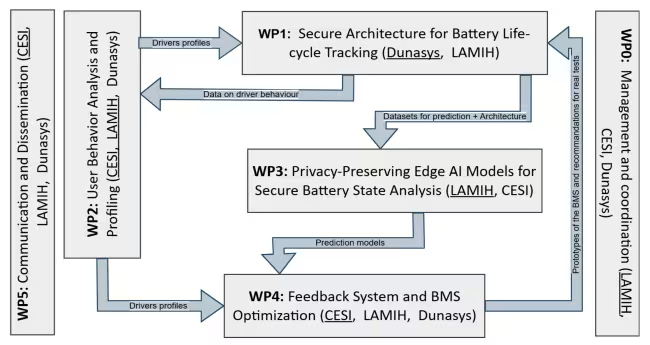
The methodology begins by enhancing the current Dunasys IoT box to improve its capabilities for securely collecting data on driving behavior, charging patterns, and battery health, integrating blockchain for transparent, tamper-proof tracking of the battery life cycle. A new data collection architecture will be developed to manage real-time, large-scale data acquisition efficiently. Federated learning will process data locally on each vehicle, ensuring GDPR compliance while enabling the development of driver profiles that allow for personalized optimization of battery usage and eventually recycling strategy. These profiles will be key in implementing AI models that optimize both battery Remaining Useful Life (RUL) and charging schedules. Charging optimization will involve analyzing factors such as user behavior, grid demand, and battery health, allowing for smart scheduling recommendations that minimize battery degradation while balancing user convenience and energy efficiency. A user feedback system will provide real-time recommendations for optimizing both driving and charging behaviors and improvements to the Battery Management System (BMS) will further enhance battery performance and extend lifespan. This holistic approach ensures secure, personalized, and optimized battery management, aligned with sustainability and regulatory compliance. To achieve the fixed objectives, the project is organized into five work packages (WPs). Each partner will coordinate one technical WP. The WP2 will be co-coordinated by LAMIH and CESI. The WP0 and WP5 are dedicated to the management and the dissemination. Figure 1 shows interactions between different WPs. The PhD thesis proposed will be co-supervised by the different partners, in order to strengthen exchanges between the academic partners and Dunasys company on the research subject. For confidentiality and intellectual property rights, the partners will sign a Non-Disclosure Agreement (NDA) to specify the parts that need to be protected (such as Dunasys's customer data, specific materials, etc.).
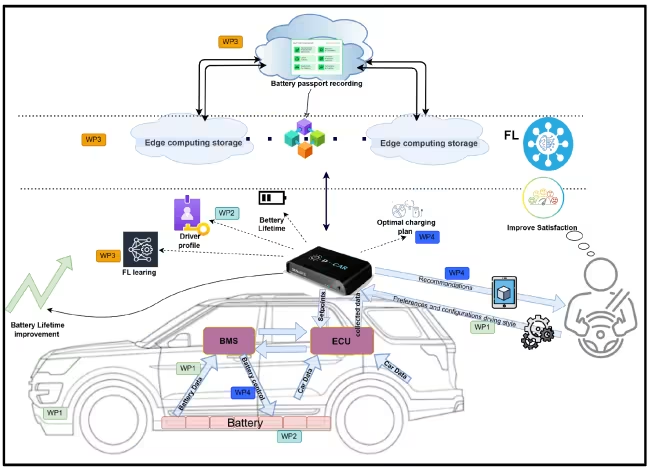
The methodology used in the project is based on the architecture presented in figure 2. Where there are three levels of data interaction. The first level concerns the component of data collection that can contain private data. The second level concerns the edge computing which is used to reduce the latency and the distributed data analysis. The high level is the use of the blockchain and the federated learning (global model). The methodology used in the project is based on the architecture presented in figure 2. This architecture is composed of three layers (vehicles layer, edge computing layer and the cloud computing layer). Each vehicle, in the first layer, will be equipped with the Dunasys IoT box. This box will have the following three main tasks: (1) a data collection task in which the IoT box will collect various information regarding the battery state and the driving style and conditions. (2) a data analysis task in which it runs learning models on the collected data. The parameters of some of these models will be aggregated on the edge computing layer enabling a federated learning approach. (3) a recommendation reception task in which the IoT box will receive recommendations regarding the adaptation of its battery charging habits and driving style. Communication through the Message Queuing Telemetry Transport protocol (MQTT) will be favored in this layer due to its lightweight nature and its adaptability to the low-bandwidth network technologies used in vehicular applications. The edge servers at the second layer will mainly be tasked to aggregate, process and store data. This layer will therefore allow the orchestration of the federated learning process and the storage of the federated model parameters. It will also be responsible for management of a Blockchain that verifies and stores the battery passport delivered by the companies. Thus, it provides a large-scale accountability service allowing to keep track of the passport in a distributed manner. Finally, the cloud computing layer will host the services provided by the companies, among which the following services are directly related to our project. The first one is responsible for the storage of information related to the clients and their battery state, while the second is responsible for an authenticated delivery of battery passports.