Since the 2000s, tramways have become established in many cities as the main mode of public transport.
Tramways are an attractive form of surface mass transit (high passenger flow, safe solution, clean energy) for local authorities. Furthermore, its cost is also lower than that of the other mass transit system: the metro. Indeed, the installation of a tramway generally generates fewer infrastructure-related constraints, as it integrates into an existing environment with other road users (cars, motorized and non-motorized two wheelers, etc.) and pedestrians.
However, this multiplicity of players in the tramway's traffic zone makes driver’s task very demanding. Anticipation is the key to safety in urban visual driving, as the stopping distances of railway equipment are very long and avoidance maneuvers are impossible.
This makes the driver state at the core of the safety of the tramway, as he/she must be constantly attentive to prevent any risk of collision with third parties, whether moving or stationary, in a context where the field of view is sometimes severely reduced (masking by buildings, street furniture, signs, etc.).
The aim of the project is to keep the driver's workload within an optimum range by means of an advanced driver assistance system (ADAS) that adapts itself in real time. To do this, it is necessary to estimate the state of the driver and the demands of the task in the current driving environment. Using these estimates, it is possible to assist the driver in an adapted way by modulating the requirements of the driving task (by reducing or increasing the driver's load).
The project approach relies on a consortium with expertise in:
- Tramway operation, safety and regulations (operator, public authority);
- Knowledge of the mechanisms involved in the evolution of human vigilance/attention (expert company in human factors);
- Design of virtual sensors based on these mechanisms, and of driver assistance systems (transport research laboratory with an automatic control department);
- Virtual tramway simulation (company specialized in simulation).
This approach will take into account the “GAME” principle (“Globalement Au Moins Équivalent” / “Globally At Least Equivalent”) defined by transport regulations and aimed at maintaining an overall level of safety. In fine, the SaferTramDriving project aims to develop a system providing:
- An estimate of the driver's actual state, notably his/her level of attention, without disturbing the driving task, i.e. without adding a new task to the driver;
- An estimate of the driving task demands, based on the state of the current driving environment (obstacles detection, speed profile, etc.);
- An advanced driving assistance, which can adapt in real-time using the previous information, allowing the driver's load to be modulated to better control his/her vigilance and attention.
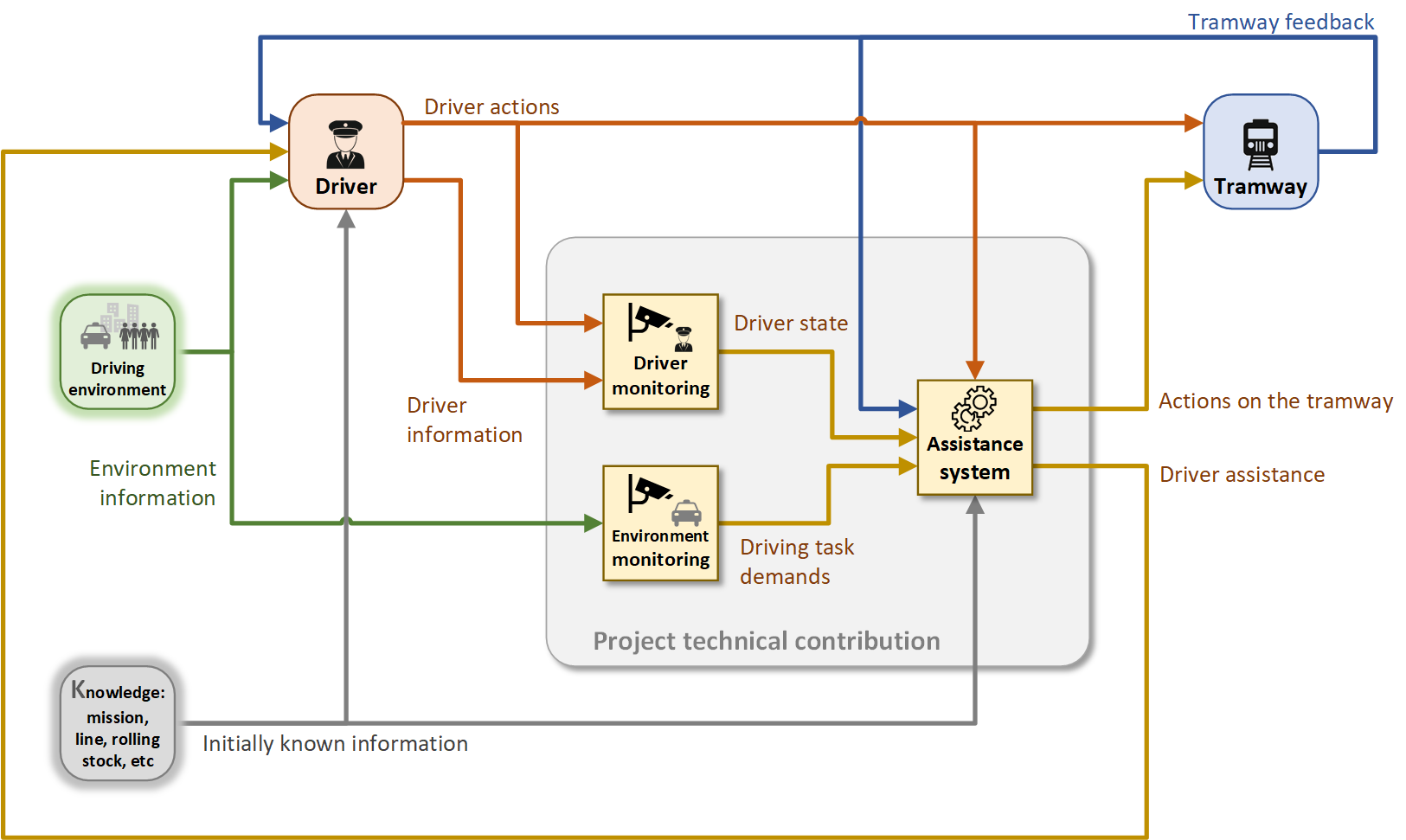
To ensure the efficiency of the system elaborated regarding the need of safety improvement, a part of the project will be dedicated to prototype and evaluate this system. The evaluation will be carried out with professional tramway drivers coming from several French networks, using a demonstrator developed as part of the project and based on a full-scale tramway simulator.
The project is funded by the ANR within the framework of the 2024 generic call for projects (CE22 – Cities, buildings and construction, transport and mobility: transition to sustainability)