




ROC Research Group (Robustness & Complexity)
The ROC research group works on the modelling, control, observation and diagnosis of complex and uncertain systems (large-scale, interconnected, human-machine systems, etc.).
Présentation
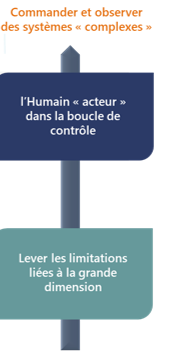
Les travaux du groupe de recherche ROC visent à développer des méthodes et outils pour gérer les différentes sources de complexité, les incertitudes et les contraintes (mesures discrètes et apériodiques, contraintes temporelles, etc.), tout en intégrant les interactions humain-système, en considérant l’Humain dans la boucle de décision et d’action.
Les principaux objectifs sont :
- Réduction de complexité des systèmes dynamiques de grande dimension, pour la commande et l’observation
- Commande et observation sous mesures discrètes et apériodiques, pour les systèmes de grande dimension ou interconnectés.
- Caractérisation, modélisation et observation de l’Humain, par hybridation d’approches data-driven et de modèles physiques
- Commande avancée, pour la sécurité et la robustesse des interactions homme-machine
Selon la nature de la complexité considérée, ces activités de recherche sont regroupées en deux axes forts dédiés à la prise en compte d’éléments de complexité liés à la grande dimension et la prise en compte de la complexité liée à la considération de l’Humain dans la boucle d’action.
Overcoming the limitations associated with large dimensions
Keywords: Control, observation, LPV, finite time, large-scale systems, multi-agent, heterogeneous, interconnected, multi-scale
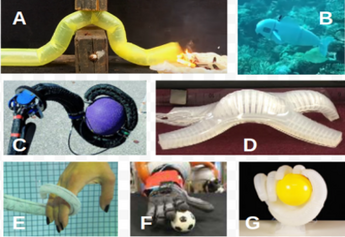
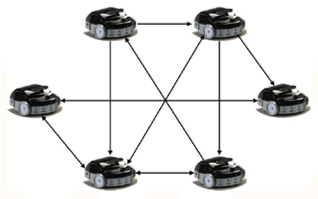
The research aims to develop control and observation methods for large-scale dynamic systems and multi-agent systems, balancing complexity reduction, theoretical guarantees and experimental implementation. It is structured around two main areas:
- Complexity reduction and preservation of structural properties: development of analytical and numerical approaches to simplify models whilst preserving their essential properties, notably stability and passivity, and taking into account the uncertainties introduced by the reduction.
- Decentralised control and observation: design of event-based and adaptive strategies that take into account the asynchronous nature and irregularity of measurements, in order to limit the number of updates to controllers and observers, whilst reducing their dependence on global system information.
Humans as ‘actors’ in the control loop
Keywords: Human-in-the-loop, human modelling and observation, shared control, automated vehicle, robotic assistance, human assistance, human-system interaction
The research aims to develop control strategies that integrate the human element into the control loop, taking into account the two-way interactions between the user and the assistance system, particularly in the areas of driver assistance and technologies designed for people with disabilities. It is structured around two main areas:
- Modelling and adaptation of human behaviour: characterisation, modelling and observation of human behaviour through a hybrid approach, in order to account for behavioural uncertainties and the adaptation processes at play during interaction.
- Human–system interaction safety: development of robust shared control strategies and hierarchical cooperative architectures to ensure the stability and safety of the interaction, whilst adapting the operation of the assistance system to the user’s behaviour and needs.