




BEHUM: Human bioengineering at various scales (Bio-Engineering of Humans at multiple scales)
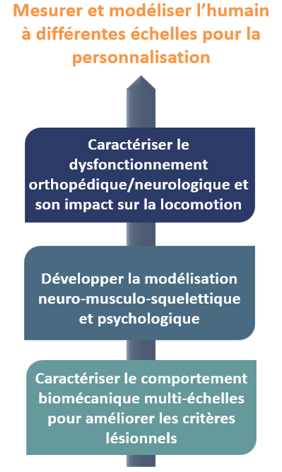
The BEHUM research group develops experimental and modelling approaches aimed at characterising the human body at different scales, from biological tissue to whole-body movement.
Its research enables a detailed exploration of the biomechanical properties of human structures and how these change under normal or pathological conditions.
The group’s work focuses on gaining a better understanding of the mechanisms underlying injuries by analysing multi-scale biomechanical behaviour.
It also aims to propose integrative models of the neuromusculoskeletal system, taking into account the interactions between physical, neurological and behavioural dimensions.
Finally, particular attention is paid to the study of orthopaedic and neurological dysfunctions and their consequences for locomotion, with a view to improving diagnosis, monitoring and the personalisation of care.
Characterising multi-scale biomechanical behaviour to improve injury criteria
Keywords: micro/meso/macro modelling, lesion criteria, characterisation
Developing neuromusculoskeletal and psychological modelling
Keywords: neuromusculoskeletal modelling, motion capture, EMG, fatigue
Caractériser le dysfonctionnement orthopédique/neurologique et son impact sur la locomotion

Mots clés : analyse du mouvement embarquée, APAS, approche biopsychosociale
La prise en charge orthopédique et sa rééducation ne peut se baser uniquement sur des données cinématiques avant et après prise en charge.
En respectant l’approche biopsychosociale conseillée par l’Organisation Mondiale de la Santé, cette axe de recherche vise à créer et regrouper de façon innovante des paramètres cliniques et descripteurs du mouvement pour l’optimisation de la prise en charge par l’activité physique.
Cette fusion de métriques permet par d’analyser de façon exhaustive la motricité unilatérale et bilatérale de la cheville et de modéliser la motricité humaine et ses dysfonctionnement liés à la douleur ou d’évaluer l’impact de la rééducation/réadaptation par activité physique adaptée après prothèse totale de hanche ou de genou.