




SIC Research Group (Intelligent & Cooperative Systems)
The SIC research group within the Department of Automatic Control brings together researchers working on issues relating to the design and control of systems, whilst taking into account the challenges of resilience and sustainability in these systems.
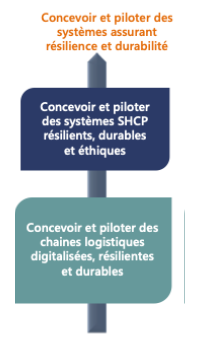
Les travaux de recherche du groupe SIC visent à concevoir et implémenter des approches intelligentes, capable d’orienter les décideurs, dans des délais les plus courtes, afin de prendre des décisions adéquates selon des indicateurs de performances prédéfinies (impact écologique, performance économique, impact sociétal).
- Ces travaux ont les objectifs principaux suivants :
- Concevoir des architectures de coopération dans les systèmes SHCP.
- Développer des méthodes de pilotage centrée sur l’humain et qui s’adaptent aux aléas et aux perturbations.
- Modéliser et optimiser les réseaux logistiques intégrant les trois axes de la durabilité.
- Améliorer le pilotage et la résilience de la chaîne logistique grâce aux nouvelles technologies et la digitalisation.
Les activités de recherche du groupe SIC s’articulent autour de deux axes complémentaires.
Le premier axe porte sur la définition du rôle de l’humain dans les systèmes H-CP, tant dis que le deuxième axe s’intéresse à la modélisation et à l’optimisation des flux logistiques au sein de chaînes d’approvisionnement de plus en plus complexes.
La durabilité et la résilience constituent des enjeux transversaux à ces deux axes.
Designing and managing resilient, sustainable and ethical SHCP systems
Keywords: Human-Cyber-Physical System, Co-operation, Resilience, Reconfigurable System, Digital Twin, Ethical Risk, Industry 4.0, predictive maintenance
The research activities under the first research area aim to design and pilot SHCPs that are high-performing, resilient to disruptions, sustainable from an ecological, economic and societal perspective, and ethical in both their design and operation. Three key pillars underpin this research area:
- Humans within the monitoring and control loop of SHCPs: modelling humans as dynamic actors within the system, taking into account their states (mental load, skills, etc.) and decision-making capabilities. This modelling will draw on data from sensors and observations, machine learning approaches and digital twins.
- Developing resilient approaches to controlling SHCPs: develop management methods capable of detecting and diagnosing anomalies, assessing their impact and reconfiguring the system.
Taking human and societal criteria into account in the design and operation of SHCPs: formalising these as measurable indicators and including them, on a par with economic and ecological criteria, in design and control models.
Designing and managing digitalised, resilient and sustainable supply chains
Keywords: Digitalised supply chain, multi-objective optimisation, sustainable logistics, industrial symbiosis, the Physical Internet, blockchain for logistics, circular economy
The research in this area aims to design and pilot digitalised, resilient and sustainable supply chains.
It is organised around three key challenges:
- the Physical Internet as a paradigm for the sustainable organisation of flows: research using this paradigm focuses on the modelling of interconnected containers and hubs, the dynamic routing of flows within an open network, the pooling of transport and storage resources, and mechanisms for cooperation between actors in the supply chain.
- Risk management for robust supply chains: Identification and mapping of vulnerabilities in the chain, quantification of uncertainties, and development of mitigation strategies
- industrial symbiosis and the circular economy as means of closing logistics loops.