


International students: on international exchange
You are a student at a partner university that has signed an agreement with Université Polytechnique Hauts-de-France (ERASMUS+, EUNICE, bilateral agreement, double-diploma) and you would like to spend a period of study or internship at the University.
How to apply
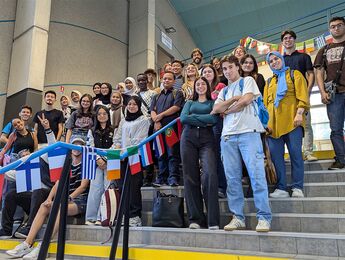
An environmentally-friendly university
Our university is on a human scale, with some 14,000 students spread over 5 campuses.
The 2 main campuses, the Mont Houy campus with its green environment (green spaces, picnic tables and sports facilities available) and Tertiales in the city center (very close to shops and the train station), are linked by the tramway (free travel for under-26s).
So you'll find plenty of natural spaces to practice sports, recharge your batteries and study!
A total French experience
You'll find Bachelor's, Master's programs in many fields of study, while offering an innovative interdisciplinary approach to the curriculum. PhD students have the opportunity to do an exchange with us and will join a research team in one of our laboratories.
. The majority of our courses are offered in French, so immersion is total!
This is your opportunity to learn, deepen and perfect your level of French.
Complete courses
We organize French as a Foreign Language (FLE) courses at the start of your mobility at UPHF that allow you a first meeting with your future exchange friends, to feel more relaxed too to start studying.
Throughout the year, it's also possible to take a B1 or B2 level FLE course of around 1h30 per week for 3 ECTS/semester that you can add to your pedagogical contract.
For students wishing to take a full FLE course, UPHF offers a DU FLE which welcomes international students of all nationalities, and wishing to enter a Licence or Master course in France the following year.
You can also join EUNICE* courses if you wish. These online courses, covering a wide range of disciplines, are often in English, but there are also courses in other foreign languages.
Finally, our three Language Resource Centers are essential resources and meeting points for language exchanges.
A dynamic city and region at the heart of Europe
The advantage of living in a smaller town like Valenciennes, in addition to enjoying a quieter life, is the cost of living! Housing, transport and everyday life are more affordable.
And Valenciennes is the region's second-largest student city, so you'll find everything you need... except the drawbacks of big cities!
Come to Valenciennes if you like:
- sports: with its Nungesser Olympic aquatic center, Hainaut stadium, skating rink, baseball/cricket stadium and more. Everything to stay in shape!
- cultural outings: its Phénix theater, Musée des Beaux-Arts and municipal library are national treasures that tell stories of the region
- .
- leisure activities: cinemas, boulodromes, laser games, escape games, paintball as well as numerous bars and restaurants in its city center won't disappoint
- .
The Hauts-de-France region is also very lively! Events such as the Braderie de Lille or the Carnaval de Dunkerque, bring together its inhabitants, nicknamed the "Ch'tis".
The Pôle de relations internationales organizes free outings for its exchange students and to help you discover our beautiful Region!
If you come to Valenciennes, you'll be able to travel easily. Our city is ideally located, close to four airports (Lille-Lesquin, Charleroi, Brussels, Paris) and connected, by major road and rail routes, to Europe's biggest capitals.
At UPHF/INSA, the vast majority of courses are taught in French. A minimum of B1 is required for a large proportion of courses (in Law, B2). Choose a course from our catalogue.
Here are a few practical tips on the subject:
- Don't mix semesters and courses; you can only select courses from the same specialty in a given semester. It is possible to admit a few courses from another course, but you'll need to check the feasibility in terms of timetables. There is a risk of having to modify the teaching contract.
- If you are at Licence / Undergraduate / Bachelor level, select only licence-level courses. On the "Diploma" drop-down menu check Licence or Bachelor Universitaire de Technologie.
- Don't select a Licence Professionnelle course or a FA-only course (alternance training), as these are not suitable for you, there are many periods in the company.
- If you're at Master's / Graduate level, you can select Master's or Specialized Engineer.
- What are a Polytechnic module and an opening module? These are courses that you can select from lists twice a year. Among these courses, you can integrate EUNICE* courses if you wish.
EUNICE*: Our European University network offers online courses in a wide range of disciplines. Get started! Courses are often in English, but there are also courses in other foreign languages.
If you wish to study in English, a minimum B2 level is required.
For courses in Science and Technology:
Select courses from the INSA (Campus Mont-Houy) "Taught in English" engineering catalog. Here are a few practical tips:
- Don't mix semesters and specialties; you can only select courses from the same specialty in a given semester.
- If you don't reach the sufficient number of ECTS credits: why not ask if a mini laboratory project is possible? Or challenge yourself to take a few courses in French?
For courses in Business and Administration:
Two courses offer a full semester in English (30 ECTS), but only in the autumn semester:
- La Licence Technique de commercialisation, specializing in purchasing and sales, taught at the Institut Universitaire de Technologie (Campus Les Tertiales)
- The Licence Gestion Management des Organisations Global Business taught at the IAE Management School of our Institut des Sociétés et Humanités (Campus Mont-Houy)
From a partner university (the general case)
You are a student from a UPHF/INSA partner university and would like to carry out a project in research laboratory. It's perfectly possible to submit an application including a pedagogical contract for studies.
It's important to plan well in advance.
It's important to make your application well in advance, at least 4 to 5 months before the desired period.
You can submit your CV, cover letter specifying the dates desired, the themes envisaged, and your university transcripts to @email
.
If the project is feasible, you will need to contact your international relations department to be nominated by our department (see "Apply" section).
It is also possible, but more rare, for this project to be rewarded, in which case it is referred to as a "laboratory internship". As the status is different, an internship agreement will be drawn up (or an Erasmus + SMT teaching contract, if applicable). In this case, you don't need to be nominated by your home institution.
In both cases, internship or project, you will be registered at UPHF/INSA and considered as a student of our establishment and benefiting from all student services (accommodation, university library, cafeterias, university restaurants, sports facilities...)
BRIDGE program
You want to do an internship or a research project in a laboratory. It's perfectly possible!
You can carry out an internship at UPHF through several frameworks depending on your situation:
With the BRIDGE program (Boosting Relations through Internship Development, Global Experience, and Education), UPHF's internationalization initiative in collaboration with renowned English-speaking institutions, you can complete a gratified internship in a research laboratory or administrative department while enjoying benefits:
- Quality assignments supervised by teacher-researchers or professionals
- Accompaniment from the International Relations Pole throughout your stay (visa, insurance, accommodation)
- Reservation of on-campus accommodation
- Access to campus services: university library, cafeterias, university restaurants, sports facilities
- French as a foreign language courses offered
The number of places is limited and reserved for students from BRIDGE partner universities (University of Victoria, University of Central Lancashire, University of Hull, Northumbria University).
- If you are a student from a partner university (see "Coming from a partner university (the general case)" )
- If you are a student coming from a non-partner university (see section "Non-partner universities" )
Non-partner universities
If you are a student from a non-partner university: your home university is not listed on our UPHF or INSA interactive maps, you still have the opportunity to apply to research laboratories.
- Consult the corresponding page and send your CV and cover letter directly to the laboratory concerned. Apply at least 4 months before the desired period, indicating which themes you wish to pursue and for what period.
- You'll be doing a laboratory internship, so you'll need to be gratified either under an internship agreement or with an Erasmus + SMT pedagogical contract, if applicable.
- A specific registration status exists and you will be enrolled at UPHF/INSA and considered as a student of our establishment and benefiting from all student services (housing, university library, cafeterias, university restaurants, sports facilities...)
Be nominated
Your nomination:
You must be selected by your home university to stay at UPHF. Get in touch with your university's International Relations department to find out how to proceed.
Apply
You have been selected and your university has sent us your application.
To take courses:
- If you would like your stay to begin in the autumn semester: before May 15.
- If you wish your stay to begin in the spring semester: before November 1
- If you wish to carry out a laboratory project: apply eight weeks before the start of the project.
Do you have a disability or long-term condition?
Please let us know on the application form, which will be sent to you after your appointment by your international department.
Our school has a service dedicated to supporting students with disabilities: le Relais Handicap. It works in close collaboration with our Health Center to help you with your university and daily life: help with organization and the smooth running of studies, travel, accommodation, catering, access to university buildings, knowledge tools, computer technologies, etc.
Constantly improving its signage and facilities, UPHF has adapted by creating easier access to its campus buildings (access ramps, special parking facilities, elevators, etc.). Feel free to consult the campus map and building accessibility (Pictoaccess)
Our accommodation partner CROUS is also able to accommodate students with disabilities, in its standard accommodation for People with Reduced Mobility (PMR).
What's more, on the Valenciennois Transport network, Transvilles, all streetcars and buses are designed to accommodate People with Reduced Mobility (PRM), i.e. anyone with temporary or long-term mobility difficulties.
The International Relations Pole will help you with all your needs:
- Before : We organize your departure with you and send you your results.
We organize your arrival with you step by step, and you'll receive information on accommodation, transport, Valenciennes, our integration seminar, administrative and educational registration, and our dedicated student services. - Throughout your stay: We remain available to help and advise you.
- At the end of your stay: We organize your departure with you and send you your results.
Accommodation
The International Relations Pole assists all exchange students in finding accommodation. You can apply to reserve accommodation in a CROUS residence in Valenciennes by applying on our forms (subject to availability).
A partnership with the private residence Nexity Studéa enables you to obtain a room of a higher standard with an application fee reduced by 75%.
For more information, visit the "Housing" page.
Entry and residence formalities in France
Citizens of European Union member countries do not need to apply for a visa to stay in France. A valid national identity card or passport is sufficient (the validity of the identity card or passport must cover at least the entire duration of the study stay).
Entry formalities - the visa
.
Depending on their nationality and the length of their stay in France, foreign students will need a visa before departure. For more information, visit the Ministère de l'Europe et des Affaires Etrangères website.
Stay requirements
.
Non-European students (with the exception of Algerian students) who have a Long Stay Visa (longer than 3 months) are exempt from the formalities for obtaining a residence permit when they arrive in France. Validation of the Visa Long Séjour valant Titre de Séjour (VLS-TS) is done online within 3 months of your arrival on the page.
Click here to validate a residence permit
Students must pay the appropriate tax directly online (Student: €50).
Financial assistance
You have the possibility, subject to meeting certain eligibility criteria, to apply for financial aid from French organizations or institutions for your study stay in France. As a first step, you should contact the international relations department or the relevant department at your home university, which will inform you of its funding possibilities.
- Scholarships from French embassies
Some French embassies offer scholarships for students to study in France. Please contact the French embassy in your home country for more information. - Directory of scholarship programs
CampusBourse is the directory of scholarship programs to help you find funding for your studies in France.
Administrative registration
Before your arrival, the Pôle de Relations Internationales will email you the link to the registration platform. You will need to complete the online form.
Important : Only students enrolled in double degree or diploma courses are required to pay the CVEC ("Contribution à la Vie Etudiante et de Campus"). You will need your attestation number when you register at the Université Polytechnique Hauts-de-France.
.
Payment of the CVEC must be made on line. The funds collected are used to finance projects aimed at improving students' study conditions. The price of the CVEC is 103€ (2024-2025)
At the integration seminar, the Pôle de Relations Internationales will issue you with a certificate of arrival and your multiservice card, which will allow you to:
- Access to university buildings
- Access and payment at university restaurants (you can credit this card)
- Access to resources available in university libraries
If you are unable to attend the integration seminar, please make an appointment with the Pôle de Relations Internationales (e-mail: @email) to obtain your attestation of arrival and to receive assistance in putting together your registration file.
Pedagogical registration
Learning registration (for students with a study contract):
The choice of courses or a project is essential for the validation of your credits.
It is set out in your teaching contract. When you arrive at the Université Polytechnique Hauts-de-France and during the first month of your stay, you can modify it. Any changes must be approved by your home university and the UPHF institute hosting you. The final document must be returned to the Pôle de Relations Internationales.
Living in Valenciennes
In 2025, Valenciennes is one of the most attractive cities for students.
Aordable and well served, the city of Valenciennes is ideally located for visiting several European capitals. Just 1 hour from Brussels, less than 2 hours from Paris by train, and just over 3 hours from London and Luxembourg. Lille can be reached in 35 minutes.
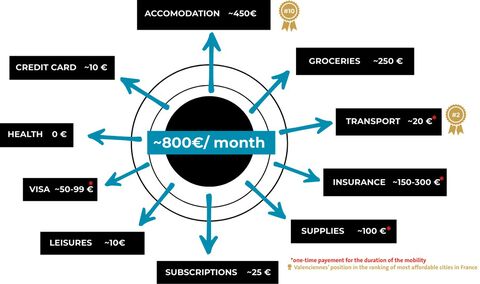
In addition to a busy train station, Valenciennes boasts a public transport network with attractive fares, making it the 2nd cheapest city in France for bus and streetcar passes for young people.
Valenciennes is also one of the top 10 least expensive cities for student accommodation. Interesting cultural and sporting activities are offered by the metropolis and the Université Polytechnique Hauts-de-France.
Valenciennes is also one of France's top cities for student accommodation.
Cost of living and financial aspects (in euros)
These rates are given as an indication only
Housing
Crous: 270€ to 580€ per month.
Private:from 410€ (18m2) to 600€ (33m2) per month.
Average student studio in Valenciennes: 433€ (source: studapart.com).
Shopping
Shopping in stores:250€ per month.
RU :€3.30 per meal.
Fast food: 10€ per meal.
Transportation
Public transport:
→ PASS&GO -25 years old - Unlimited and free (€20 application fee). Criteria may apply.
→ +26 years: Pass Lib subscription - €38.50/month.
A Valenciennes-Lille train ticket (one-way): €10.80 or €5.40 with a "Hauts-de-France -26 ans" card (which costs €15/year).
Visa
Visa fee: €50 (via Etudes en France) if country with Etudes en France procedure, otherwise €99.
Insurance
Personal and housing: 150 to 300€ (for a semester or a year).
Health: Free of charge. The European Health Insurance Card gives you access to the same healthcare reimbursements as a French citizen. If you don't have this card you can register with Sécurité Sociale free of charge.
. For optimum coverage of your healthcare expenses, you can subscribe to a complementary health insurance plan or a mutuelle.
Supplies
Books, school supplies, software, copies...: approximately €100 for the mobility period, depending on your consumption.
Health
Health insurance: Intra-EU student: European Health Insurance Card (EHIC) and Extra-EU student free of charge.
Consultation fees: €30 for a consultation with a general practitioner. Specialists may cost more. UPHF offers consultations with a general practitioner without advance payment at its Health Center.
Means of payment
Bank account fees: variable.
Cost of bank card: €10 per month on average. Online banks may offer cheaper services (free bank card, lower management fees...)
Hobbies
Cinema: €10 per ticket.
strong=""> 5€ per hour for students.
Le Phénix (show) : 6€ for students (some programs are more expensive).
Sport: Free at UPHF (provided you have a UPHF student card). You can practice several activities.
Gym:from €24.99.
Subscriptions
Telephone with internet: 10€ per month minimum. For a box, allow at least 25€.
Please note:as an international student, you'll need generally high internet consumption (WhatsApp, Maps etc.)
Additional tips
→ You need to allow enough margin when you arrive, as expenses will be higher.
→ Make sure you have access to cash.
→ There are online banks that offer cards with no fees (excluding delivery of the physical card).
→ Look for "student" prices, as it's common for a reduced price to be available for museum admissions, transport passes or in certain stores...
It's advisable to allow a monthly budget of €800 to live in Valenciennes while enjoying leisure activities.
Useful links:
→ https://erasmusplay.com/fr/valenciennes/erasmus-in-valenciennes.html
→ https://www.uphf.fr/vie-campus/bien-vivre/faire-sport-luniversite
→ https://etudiant-etranger.ameli.fr
The integration seminar
The International Relations Pole organizes an integration seminar every semester to welcome its students arriving under an exchange agreement.
On the program:
- Presentation of the University and the various services offered to students.
- Tour of the campuses
- The ESN (Erasmus Student Network) association welcomes you and will support you throughout the year
- Meetings with representatives of the various training components and student associations
- Visit of the city of Valenciennes and recreational and sports activities
This free integration seminar takes place at the end of August for odd-semester arrivals and at the beginning of January for even-semester arrivals on the Mont Houy Campus.
More information will be sent to you by the Pôle de Relations Internationales when you are accepted.
Cultural outings
Throughout the year, the Pôle de Relations Internationales offers students the opportunity to take part in outings to facilitate their integration. These outings also aim to help them discover our region and its riches. The activities are free and paid for by the University.
Examples of activities:
- Cultural visits: Musée du Louvre-Lens, Musée de la Piscine in Roubaix, Domaine de Chantilly and many more.
- Sports activities: Accrobranche, skating rink, paintball among others
- But also a visit to Valenciennes or an outing to Parc Astérix!
What to do when you leave
Before you leave, please contact the Pôle de Relations Internationales, which will issue you with an end-of-stay certificate.
At the end of the semester and after your exam period (including any make-up session) or project defense, the component coordinator will communicate your grades to the Pôle de Relations Internationales, which will draw up your official ECTS transcript (see explanations on the grading system and transcript).
.
You will receive a copy by e-mail. The original will be sent to your university by email and post on request.
Cellule Mobilité Pôle de Relations Internationales
Campus le Mont Houy (Aulnoy-lez-Valenciennes)
Bâtiment Matisse
1st floor
Tel : 03 27 51 77 32 /10 27
@email